
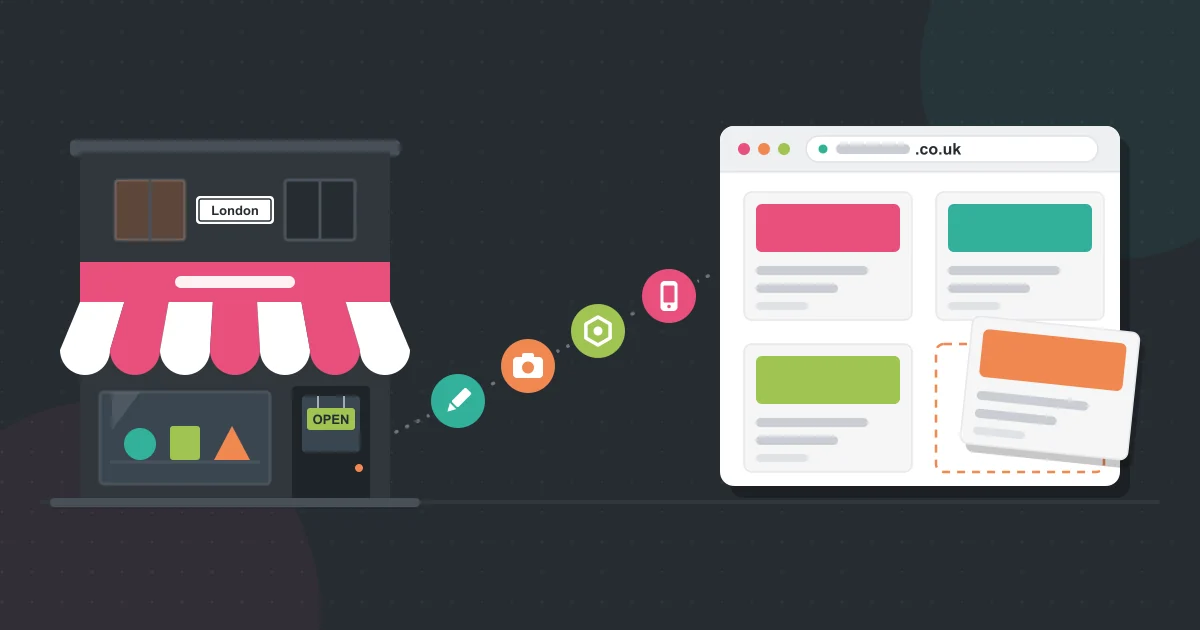
When you open a new business in London, the list of things to do is long: a bank account, an accountant, signage, stock. The website often ends up at the bottom, mostly because it is not obvious where to begin. Before you start ringing round for quotes, there are a few things worth deciding and gathering yourself. This guide sets out the steps for getting a website for a new business in London, in the order you should take them.
Should you start your website before or after you open?
Before, if you can. Building a website is more than design. The words have to be written, the photographs taken, and you need time to read it all and approve it. You will not have that time in your opening week. Not everything has to be ready for day one, either. A simple site that shows your business name, what you do, where you are and how to reach you is enough to open with. The rest can be added once things settle down.
How do you choose a domain name that fits your business?
A domain name is your website's address on the internet, such as yourbusiness.co.uk. Choose one that is as close to your business name as possible, short, and easy to type after hearing it once over the phone. Unusual spellings, numbers and extra hyphens all cause trouble when you read the address out to someone. For a business serving customers in the UK, a .co.uk address is a sensible choice because it tells visitors you operate here.
The point that matters most is whose name the domain is registered in. A web design company can register it for you, but the registered owner should be you or your company. That way the address stays with you even if you change supplier later. It also helps to check that the domain is available before you settle on the business name itself.
Which pages does your website need on day one?
Starting small is usually the right call. For a newly opened business, four pages do most of the work: a home page that says who you are and what you do at a glance, a page describing your services or products, an about page that shows who is behind the business, and a contact page. If your services are very different from one another, giving each its own page once things are up and running makes you easier to find in searches. Two more things should not be forgotten from the start. If you collect personal information through a form or in any other way, you need a privacy policy. If you trade as a limited company, your company details must appear on the site, and if you are a sole trader you should make clear who is behind the business and how to get in touch. We cover both in more detail in our guide to web design in the UK.
Do not create pages for things you do not have yet. An empty gallery or a blog with a single post makes the site look unfinished. Customer reviews, examples of your work and frequently asked questions build up over time and can be added then.
What should you prepare before you speak to a web design company?
One of the common reasons a website runs late is not the design but the content. If you go into your first meeting having thought about the four things below, the work moves faster and the finished site says more about you.
Will your website be in more than one language?
London is a city of many languages. If a good share of your customers are more comfortable in a language other than English, plan the site in both languages from the beginning. Every page will need its text in each language, so the decision affects both the timescale and the notes you prepare. Have each version read by someone fluent in that language, so it reads naturally and not like a translation.
Who will write the words?
Nobody knows your business better than you do. You do not need polished sentences. A few lines of notes for each service are enough: what you do, who it is for and what a customer can expect. Write down the questions customers ask you most often as well. A good web design company will take those notes, organise them and shape them for the site. Without them the text stays general and could belong to any business.
Where will the photographs come from?
Real photographs of your own premises, your team and your work build far more trust than stock images taken from the internet. A professional shoot is not essential. Clear pictures taken in daylight, with the phone held sideways and the place tidied first, are good enough for most sites. Photograph the same spot from a few angles and send the original files without shrinking them. Resizing is the designer's job.
What if you do not have a logo yet?
If you have a logo, ask your sign maker or designer for the original file. A photograph of a business card looks blurred on a screen. If you do not have one yet, the site can still go ahead. Your business name set in a clean typeface and a single colour looks better than a logo made in a hurry. Using the same colours on the site, the signage and your social media helps customers recognise you wherever they see you.
How will customers contact you through the site?
This needs answering before the design starts, because the layout is built around it. For a restaurant the priority might be bookings or a phone call. For a building firm it might be a quote form that accepts photographs. For a barber it might be appointments or a WhatsApp message. Pick one as the main route and have it placed where it is easy to see on every page. Your phone number, address and opening hours should appear as text, not inside an image. The phone number should also be added as a link that starts a call when tapped, so someone on a mobile can ring you with one touch. Decide early which email address the form messages will go to, and who checks it and how often.
When should you set up your Google Business Profile?
A Google Business Profile is the free listing that shows your business on Google Search and Maps with its address, phone number and opening hours. The best time to set it up is alongside the website. After you add the profile, Google asks you to verify that the business is yours. According to Google, customers can find your business on Search and Maps once you add and verify your Business Profile, so do not leave this step until the last day. Write your business name, address and phone number exactly as they appear on your website and anywhere else your business is listed. When the site goes live, add its address to the profile too. Google's Business Profile help page explains how to set one up step by step.
What should you do in the first week after your website goes live?
Start by using the site as a customer would. Open it on your own phone, visit every page, tap the phone number and send yourself a test message through the contact form. Do not assume the form works until that message has reached you. Then put the website address everywhere people already see you: business cards, signage, vehicle lettering, invoices, your email signature and the profile section of your social media accounts. Your first visitors will most likely be people who already know you, and getting the address to them is in your hands.
Frequently asked questions
I already have social media accounts. Do I still need a website?
They do different jobs and one does not replace the other. Social media helps people notice you, but the platform sets the rules for your account. A website belongs to you and can be found on Google. We explain this in full in our guide on social media or a website.
How long after my website goes live will it appear on Google?
There is no fixed answer. Google's own documentation says that even for pages you specifically ask it to crawl, crawling can take anywhere from a few days to a few weeks, and that the request does not guarantee the page will be included in search results. In the meantime, adding the website address to your Google Business Profile and sharing it with your customers helps people reach the site.
Can I update the website myself later?
That depends on how the site is built, so ask before the work begins. If you want to change things that move often, such as opening hours, a price list or photographs, ask for the site to be delivered with an admin panel, meaning a screen you log in to where you can edit the content yourself.
In short
A website for a new business comes down to a handful of steps that are not difficult when taken in order: a domain registered in your own name, a few complete pages with the required legal information, a clear decision on languages, your own notes and your own photographs, one obvious way to get in touch, and a Google Business Profile that carries the same details as the site. With that preparation you will get a better result whichever company you work with. If you have a question while planning your website in London, we at Digiso London are glad to help.